Healthcare & Admin
Decoding the French Social Security Number: 15 Digits That Tell You a Story About Someone
Your carte Vitale number isn't random. Once you know how to read it, those 15 digits reveal your sex, birth month, birth year, and birthplace — plus why getting the card takes so much longer than anyone tells you.
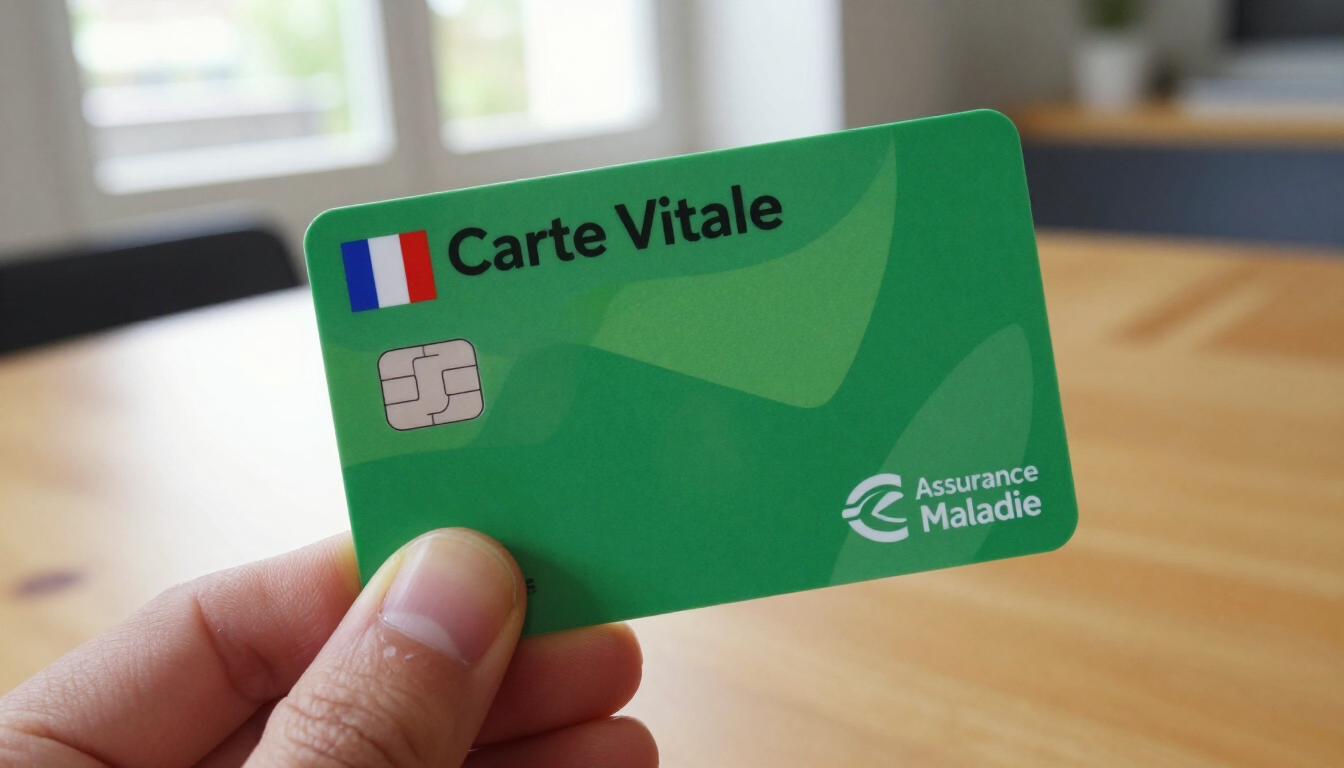
No surprise that the country that invented the metric system also came up with a way to create a unique number for every inhabitant — yes, I'm referring to the French social security number. Have you ever wondered what the 15 digits on your carte Vitale actually mean? Once you know how to read someone's Social Security Number, you'll know some basic facts about that person's life.
The Official Name Nobody Uses
"Numéro de sécurité sociale" is the name everyone uses, but the official term is NIR — Numéro d'Inscription au Répertoire, short for the Répertoire National d'Identification des Personnes Physiques (RNIPP). This register is managed not by the health insurance fund (CPAM) but by INSEE, France's national statistics institute — which tells you something about how the French state thinks about identity: first as data, then as healthcare.
The NIR is composed of 13 digits that actually encode information about you, followed by a 2-digit checksum — 15 digits in total, all of them printed on the front of your carte Vitale.
The Anatomy of the Number
Reading left to right, here's what each block means:
1st digit — Sex: 1 for male, 2 for female. (This is a legacy binary system baked into a decree from 1941 and has never been revised, which occasionally makes headlines in debates about gender identity and administrative records.)
Digits 2–3 — Year of birth: The last two digits of your birth year. Born in 1990? 90.
Digits 4–5 — Month of birth: 01 to 12 for a normal birth month. If your exact month is unknown (common for some people born abroad), a conventional code like 20 is used instead.
Digits 6–7 — Department of birth: The INSEE code of the French département where you were born (Gironde is 33, Paris is 75, and so on). If you were born outside France, this becomes 99, with a handful of exceptions: people born in Algeria get 91, 92, 93, or 94, Morocco gets 95, and Tunisia gets 96 — a numbering scheme that's really a fossil of France's colonial administrative history.
Digits 8–10 — Commune of birth (or country, if born abroad): The INSEE code of your birth municipality. If you were born outside France, these three digits instead encode the country of birth.
Digits 11–13 — Order of registration: This is the one people find counter-intuitive. It is not your birth order for the day — it's simply your rank among births registered in that commune, for that month, in that year, in whatever order the civil registry happened to log them. It reflects paperwork, not chronology.
Digits 14–15 — The control key: A checksum from 01 to 97, calculated mathematically from the first 13 digits (essentially 97 minus the remainder of that 13-digit number divided by 97). Its only job is to let a computer instantly flag a mistyped or fraudulent number.
Try It Yourself
Take a woman born in March 1990 in Paris. Her number will start 2 90 03 75, followed by the Paris commune code, her registration order, and finally the control key. Anyone who knows how to read this can immediately tell your sex, your birth month and year, and roughly where you came into the world, just from a number printed on a plastic card in your wallet.
It's an elegant piece of engineering. It's also, when you think about it for more than five seconds, a fairly striking amount of personal data to be legally required to hand over to your pharmacist.
Why Getting the Number (and the Card) Takes Forever
Here's where the elegance of the system runs headfirst into the reality of French administration.
If you're born in France: your NIR is generated automatically from the birth declaration your parents (or the maternity ward) file with the mairie, which transmits the civil-status data to INSEE. For French-born citizens, the number essentially exists before you do anything about it.
If you arrive in France as an adult — through work, study, or residency — the story is entirely different, and this is where the process really begins.
Step 1: The Provisional Number (NIA)
When you first register with the Assurance Maladie (health insurance) as a newcomer, you're not immediately given a definitive NIR. Instead, you're issued a NIA — a Numéro d'Identification d'Attente, a temporary waiting number that starts with 1 or 2 just like a real NIR and confers the same social rights. It's meant as a stopgap while your identity documents are verified against the civil registry.
The problem is that this "temporary" number can genuinely be your everyday reality for months. Case volume at the CPAM and identity-verification backlogs mean that assigning a NIA alone can take a minimum of around two months, and it's not unusual to see people still holding a provisional number three months later, with no correspondence in sight. During this period, you cannot access your online ameli account, and — critically — you cannot order a carte Vitale, because a physical card can only be issued once your NIR is definitive.
Step 2: The Definitive Number
Only once your identity has been fully certified does your NIA convert into a permanent NIR. On paper, the administrative instruction time for a complete file is quoted as 2 to 4 weeks. In practice, that clock only starts once your dossier is deemed "complete" — and complete is a moving target, since it's common to be asked for an additional supporting document weeks into the process, which resets the counter.
Step 3: Actually Getting the Card
So when someone tells you "getting your carte Vitale takes about three weeks," they're usually only describing the very last leg of a three-stage relay race.
Once — and only once — you finally have a definitive NIR, you still have to separately request the carte Vitale itself. If you order it online via your ameli account, the official estimate is about 2 weeks; by mail, it's closer to 3 weeks. That's a third waiting period, stacked on top of the two before it.
The realistic timeline from first appointment at the CPAM to the card landing in your mailbox: (1) Provisional NIA assigned — 2 months minimum; (2) NIA converted to definitive NIR — 2 to 4 weeks, if the file is complete on the first try; (3) Carte Vitale manufactured and mailed — 2 to 3 weeks. Add it up, and our clients typically wait between three and four months once we've submitted a complete file to CPAM.
The Good News: You're Not Left Without Healthcare
The system does have a safety net. As soon as you're affiliated — even with just a provisional NIA — you have the same rights to reimbursement as anyone else; you simply can't use the automated tiers payant system at the pharmacy counter. And while you're waiting for the physical card, your attestation de droits (a downloadable PDF proof of coverage from your ameli account, or a paper version from the CPAM) is fully valid administrative proof in the meantime.
The French social security number is a small masterpiece of bureaucratic engineering. But the elegance of the number has very little to do with the speed of the process that produces it. If you're navigating a first registration, budget for months, not weeks.
How France Made Easy Can Help
Registering with the French health system — assembling the right documents, submitting them correctly the first time, following up when the CPAM goes quiet — is one of the administrative services we offer specifically for newcomers to Nouvelle-Aquitaine. We've guided clients through this process many times and know exactly which documents are required, which pitfalls reset the clock, and how to keep things moving.
Our Social Security registration service covers the full CPAM registration process: document preparation, submission, and follow-up until your definitive NIR is confirmed. If you'd like to understand what's involved for your specific situation, get in touch for an initial conversation.
You might also find helpful
Need help navigating France?
We guide buyers and newcomers through every step — from property search to administrative set-up.
Book a free consultation · See all services